
Zombies Aren't Real Beginner Guide: Plan, Deploy, Adapt
Plan the first outbreak, place a workable defense, and learn when to restart in Zombies Aren't Real.
What is the core loop?
The game gives you a bird’s-eye view of a real-world city and time to prepare before the outbreak begins. You spend limited resources on military forces and protective infrastructure, start the scenario, then respond as zombies fan out and infect the population. Eliminating every zombie wins the mission; your score is based on how many civilians survive.
That structure makes preparation important, but not rigid. The store page explicitly says you can adapt your plan while the infection spreads. A good beginner mindset is to build a defense that can be adjusted, rather than trying to predict every movement before the first zombie appears.
What should you do before starting?
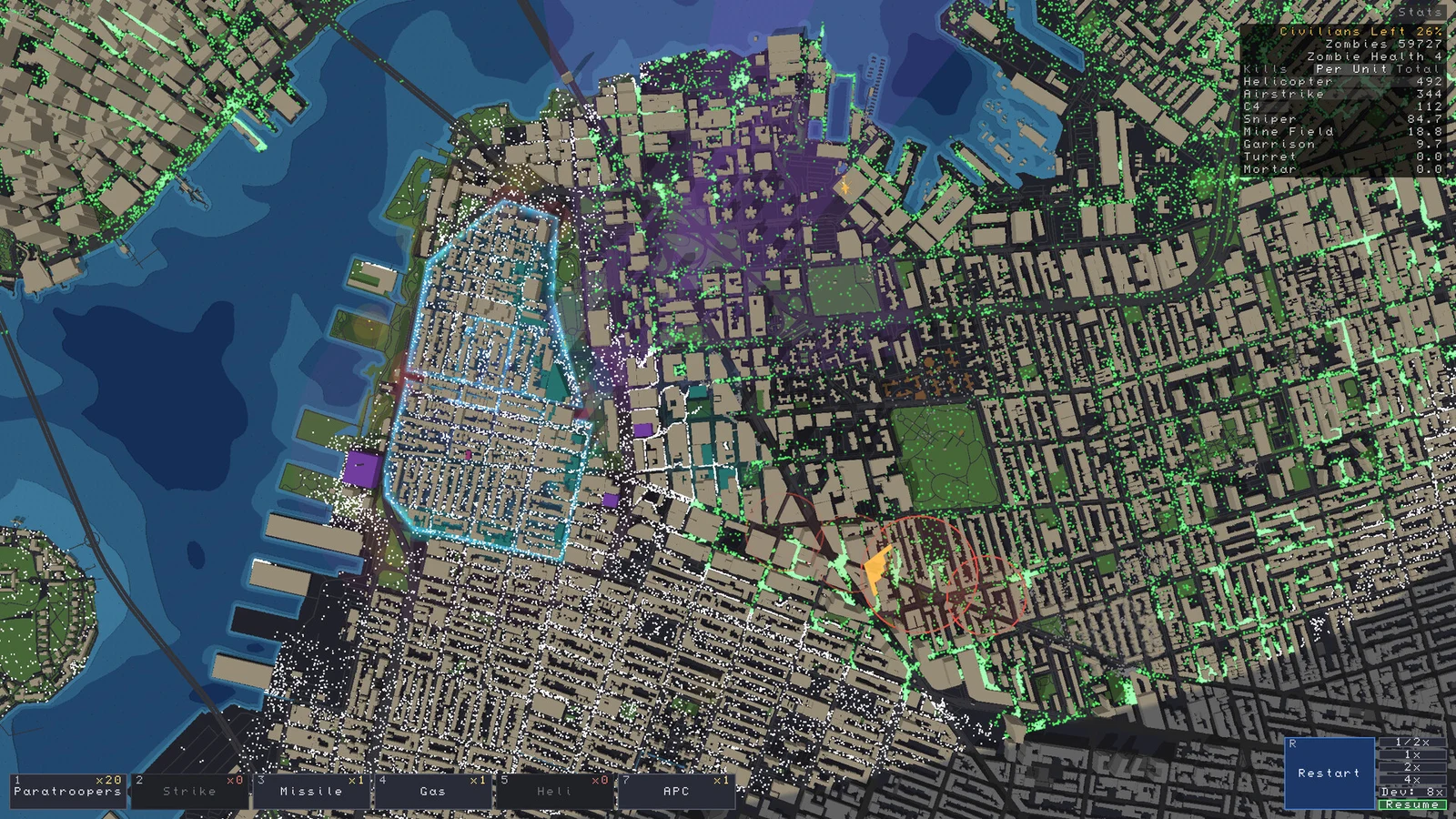
Read the city layout first. Look for major roads, bridges, open areas, and neighborhoods where civilians are concentrated. Those features influence how quickly a problem can travel and where a fallback line might be useful. The official material does not publish a universal build order, so treat any opening plan as a hypothesis to test.
Next, decide what the defense is protecting. A formation that only guards one approach may leave another district exposed. A formation spread too thinly may fail wherever the horde concentrates. Start with a coherent perimeter or protected zone, keep some response capacity available, and avoid spending everything on one isolated strongpoint.
The civilian protection guide covers this trade-off in more detail. If you want to understand the broad tools first, read the overviews of ground forces and defenses.
How should you react once the outbreak starts?
Watch for the first place the defense bends. Repositioning a unit or committing an emergency tool early is often more useful than waiting for a complete collapse. The game’s own description emphasizes adapting on the fly, and the retry-focused design suggests that a failed run is information, not wasted time.
When a breach happens, ask three questions in order: Can ground forces close it? Are civilians directly in danger? Is air support necessary? Air strikes can stop a surge, but the store page warns that they must be aimed carefully to minimize civilian casualties. Use air support as a response to a real emergency, not as the default answer to every group of zombies.
When should you restart?
Restart when the current plan can no longer protect a meaningful number of civilians, or when you can clearly name the mistake you want to correct. Do not restart merely because one position failed. First check whether a fallback, a repositioned unit, or a safer protective layout could still recover the situation.
On the next attempt, change one major assumption: the perimeter shape, the balance between ground forces and infrastructure, or the amount of emergency support you keep available. This makes each retry a comparison instead of a repeat.
What is a reasonable first success?
A reasonable first success is not a perfect score. It is a completed mission where you can explain why the defense held, which areas nearly failed, and what you would change next time. Civilian survival is the scoring measure, so a narrow military win with heavy losses is still a lesson in what to improve.
Keep your first plans simple. Establish a defensible core, preserve civilians where possible, and learn how the infection moves through the specific city. Once that loop feels clear, experiment with more aggressive layouts and specialized loadouts.
Sources
Related Articles
guides
Zombies Aren't Real Co-op Guide: One Friend, Clear Roles
Make one-friend online co-op easier with clear roles, shared priorities, and a practical restart routine.
guides
Zombies Aren't Real Defense Strategy: Protect More Civilians
Build a practical defense strategy in Zombies Aren't Real with safe zones, covered approaches, evacuation routes, and air support.
guides
Zombies Aren't Real Best Units: Unit Roles Compared
Compare garrisons, mortars, snipers, and turrets by their reported uses, with sources and no invented tier rankings.
Was this helpful?
Thanks for the feedback!